Individual
A self-facilitated program to boost your mental fitness for personal and professional growth
This website will offer limited functionality in this browser. We only support the recent versions of major browsers like Chrome, Firefox, Safari, and Edge.

Select the experience that fits your needs
A self-facilitated program to boost your mental fitness for personal and professional growth

A self-facilitated mental fitness program with exclusive pricing for 2 to 25 individuals

Explore coach-led mental fitness programs with workshops tailored to your organization
Leadership & Teams
When mid-year hits, leaders across industries often run into the same problem. Their teams are slipping behind on mid-year targets. When output drops, your instinct is to push your team harder. That makes sense. More effort should bring the numbers back up.
But sustained pressure does the opposite. When you push a stressed team, they don’t produce more. Their Saboteurs just get louder, and as those automatic patterns take over, your people lose the very thing you need most from them: the ability to think clearly and innovate.
Picture a hand on a hot stove. A quick flash of pain helps you because it makes you pull your hand back. But if you leave your hand on the burner long after the warning has done its job, you only cause damage. Sustained pressure works the same way on a team. A little early stress can sharpen focus, but past that point, your team simply absorbs the harm.
You see it in the meeting where everyone goes quiet and guarded, or in the one team member who micromanages until no one else wants to collaborate.
It’s hard to carry mid-year pressure while you watch your team members wear themselves down. Here’s the encouraging part: you don’t have to push harder to turn it around. High-performing teams have learned to take their own hands off the stove, and you can teach your team to do the same.
In the Positive Intelligence framework, Saboteurs are automatic mental patterns that work against you. Each person picks them up early in life, back when they need them to feel safe, and repeats them so often that they become automatic. They aren’t character flaws. They’re old survival strategies that keep showing up long after the threat is gone.
Saboteurs sound exactly like your team’s own reasonable thoughts: Better not raise this in the meeting. I should just handle it myself. We can’t afford to slow down now. The universal Saboteur is the Judge. This is the voice that finds fault with people, with others, and with how things are going. Under pressure, the Judge gets louder, and it drives much of the blame and second-guessing that slows a team down. Your team’s Saboteurs live in the Survivor Brain, the reactive part that scans for danger before anyone can think clearly.
Here’s the trap. The more pressure your team feels, the more their Saboteurs take over, and the narrower their thinking gets. People stop feeling comfortable sharing half-formed ideas. They protect their own corner. They miss the answer that was sitting right in front of them. The exact moment you need their best thinking is the moment their Saboteurs make it hardest to reach.
The good news is that everyone on your team has another part wired for clarity: the Sage. The calm, wise, and resilient part of us, the Sage sees a situation clearly, meets it with curiosity instead of fear, and finds the creative path forward. Your team can train the Sage like a muscle. The more they use it, the stronger it grows, and the faster they reach it when the pressure is on.
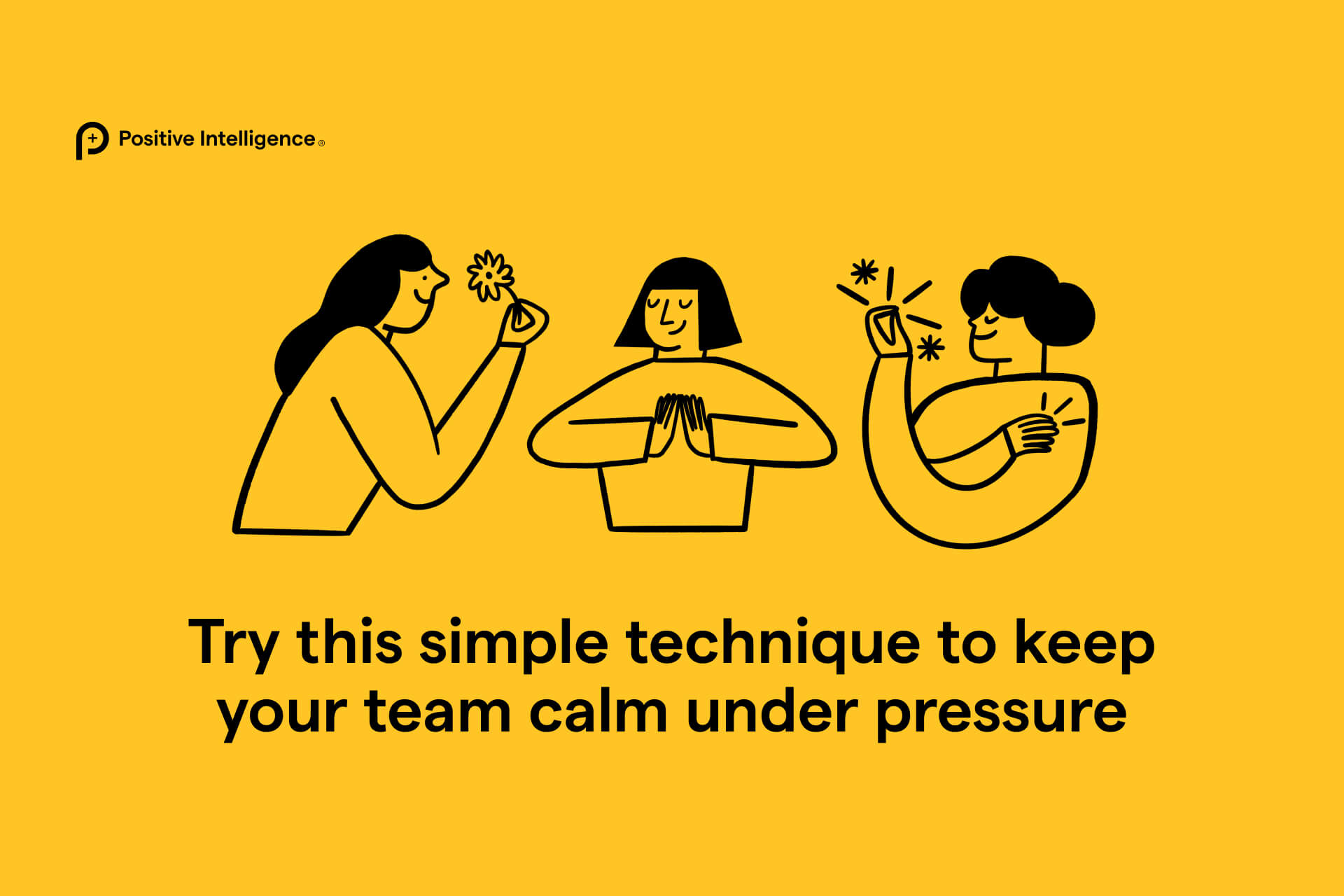
To reach the Sage on demand, your team needs a simple 10-second exercise called a PQ Rep. Here’s how it works: you place your full attention on your body or one of your five senses for about 10 seconds.
PQ Reps are simple, but they do real work. When you pull your attention off your racing thoughts and onto a physical feeling, you quiet your Saboteurs and tap into your Sage. Research with more than 500,000 participants shows that when you do PQ Reps often, you build new pathways in your brain that stay active even after you stop.
Now picture that shift happening across a whole team at once. When everyone in the room does PQ Reps together, you reset the energy of the group, not just one person. The team feels less tension, and they can approach challenges from their Sage instead of their Saboteurs.
Here’s what makes this doable: your team doesn’t have to carve out time for PQ Reps. They can attach reps to their daily habits.
A few ways to build PQ Reps into the workday:
Your team’s Saboteurs will show up throughout the day, and you can put them to work. Encourage people to name their Saboteurs when they catch them, without shaming themselves or others. When perfectionism stalls a project, someone can say, “I think the Stickler is running this meeting right now.” Naming the pattern separates it from the person, and it becomes the cue for some PQ Reps and a reset.
Your team can do PQ Reps on their own, anytime, anywhere, even in the middle of a meeting. That makes the habit far easier to build than traditional meditation, which often requires a quiet room and a block of time. If your team wants a supported place to start, the PQ Gym offers guided PQ Reps sessions they can follow together.
You don’t build a high-performing team by piling on pressure when the numbers dip. You build it by helping your people take their hands off the stove, quiet their Saboteurs, and energize their Sage together, 10 seconds at a time, until clear thinking becomes how your team works when the pressure is on.
Curious which Saboteurs show up on your team under pressure? Have your team take the free Saboteur Assessment to find out.